Poem: “For Grandma”

My family and I lost someone very special to us this month; my grandma of 88 years, passed away Friday, May 8th. While words don’t really do her justice – (I’ve never had this problem before!) It certainly doesn’t hurt to try.

So, I wrote a poem to honor her, which I read at her memorial service. Afterwards, everyone came up and told me how great it was, how “perfect” it was and fitting for her. But inside I felt empty. A part of me was pleased that everyone liked it, but I didn’t feel like I deserved it; it wasn’t good enough, it didn’t feel complete. But I think it was because, in this case, words can never really express how someone was in life, how much they mean to you, how much you ache and feel sorrow because they are gone.

I think there comes a time (even for a writer) when words just aren’t enough. No matter how much you try. Regardless, my grandma was a beautiful woman inside and out…and I did it to honor her.

grandma rose

(Or if you click on my beautiful picture you can see a larger image and read the poem there.)

It reads:

The woman who loved the color purple

had laughter on her lips


and everywhere she walked and talked

there was a purpose to her quips


She was always there to lend an ear

no judgement in her mind


She was always there for everyone

hard-working, mischievous and kind


The woman who loved to laugh and camp

had compassion in her eyes


She didn’t have to do everything

but by golly, she did try!


She was a woman of many names

and as busy as can be


But no matter what you called her

she was always “Grandma” to me.


Poetry: I can write haiku, can you?

It’s snowing outside, tiny flakes coming down from the sky in all directions, swirling chaotically around cars and the pavement outside my window.

View from my office window.

View from my office window.

Naturally this makes me want to write, of course. I don’t know what it is…maybe because it’s warm in our apartment, I woke up refreshed (finally) after a good nights sleep and I have the day off from work.

Maybe there’s something in the way that snowy sleepy days naturally put me in a thoughtful mood, and thoughtful moods generally lead to writing…if I were a painter, I’d paint the heck out of a glorious snowy day, but alas, the best brush I have, is the brush of words on blank, blank paper.

And of course, the last sentence I just wrote had me thinking about haiku poems. It’s been ages since I’ve written one…not since college three years ago. I found a refresher at this website, here.

(From the website:) The haiku is a Japanese verse in three lines.  Line one has 5 syllables, line 2 has 7 syllables and line three has 5 syllables. Haiku is a mood poem and it doesn’t use any metaphors or similes.

wpid-img_20141127_165052481.jpg

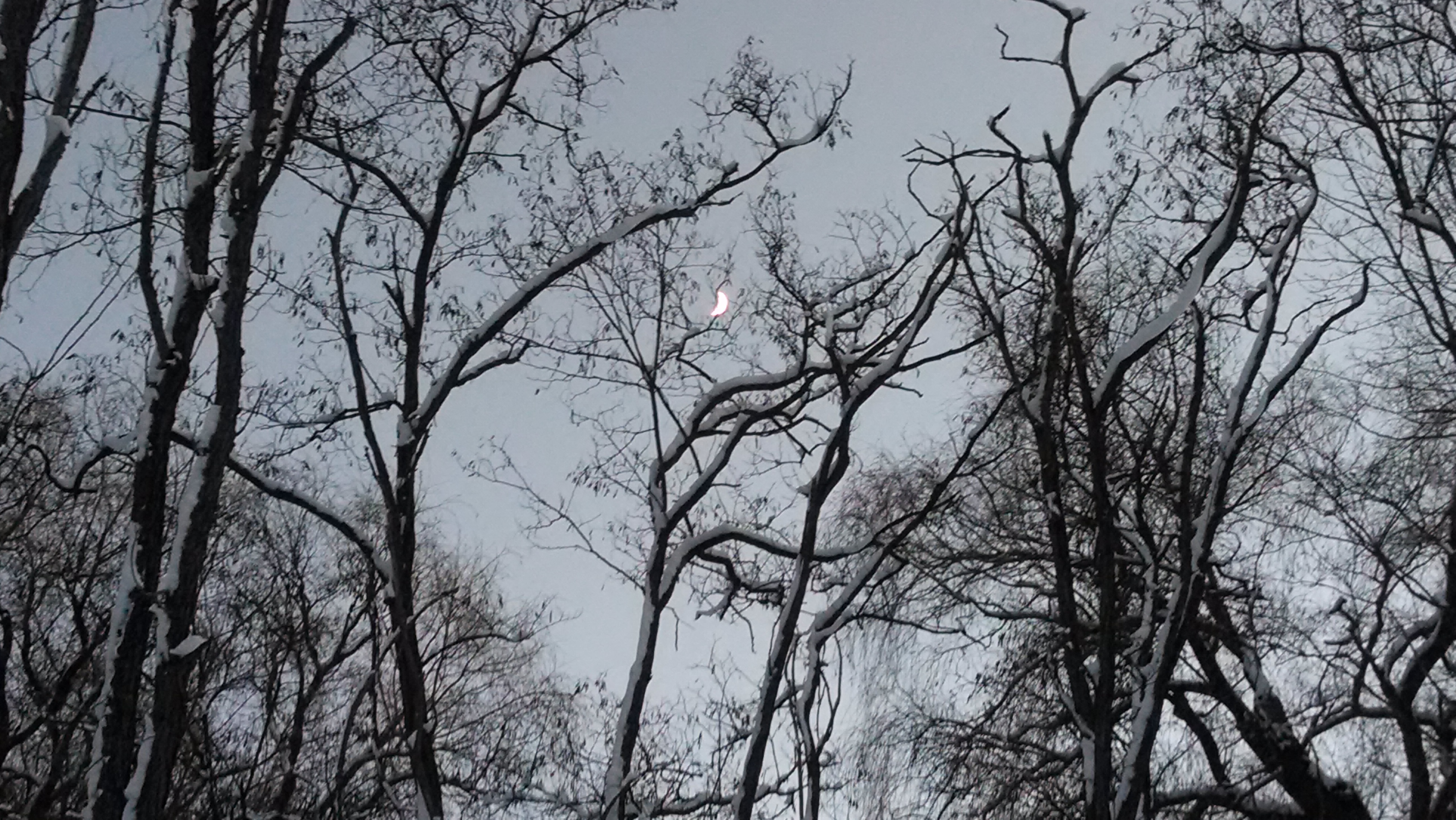
View of the moon and snowy trees at my Grandma’s house, the evening of Thanksgiving.

I don’t usually think of myself as a poet. My advance poetry teacher in college said to me once, “You are definitely a fiction writer.” And that seemed to cement the idea in my brain. He didn’t mean to say that I was inept at poetry, just that eventually all writers make a choice, and I am a lover of stories and so naturally fiction was my style of choice.

But lately, I am constantly reminded by poetry why writing descriptive, lyrical words are so important. Why some fiction is just poetry in an extended form. In a single poem, an image is created in just a few words. I think poetry is a great way to remind fiction writers how important it is to show, not tell what is happening in the story, but to focus on the concise, and descriptive words.

Here’s some haiku of my own. Some silly, some serious, some not really haiku poems at all, but all poetry:

The bright yellow sun shines

through icicles hanging

on the windowsill


icicles remind

us to mind the cold weather

bundle up you beasts


dogs don’t like the snow

wagging their tails between gusts

shivering snow and wind


the snow swirls around the pavement

children walk by with parents

hands howling in their gloves


So much depends upon a red wheelbarrow…

(Just kidding! haha…can’t get this poem out of my head for some reason! For those that don’t know this is the start of a poem, “The Red Wheelbarrow,” by William Carlos Williams. I remember there were those that either loved it or hated it in my poetry class. There was a great debate that followed about it.)

And lastly, another haiku of my own:


The dead of winter

snow falls down on black pavement

eat lunch, eat sunlight

This has been a lot of fun for me this afternoon. Feel free to comment with your own, if you like!

Happy Writing!

Writing Prompt #38: “Oops”

Writing prompt # 38: You turn a corner at work and bump into a coworker, spilling your coffee on them.

“Oops,” you say, and laugh as coffee

spills down a mound of breasts

and a shirt now stained the color

of dirty milk

She was the bitch who told you to copy that file

as soon as possible  was the one

who told you, don’t forget there’s a meeting at 10

don’t forget to button your shirt

don’t forget about the coffee stains on your desk

don’t forget

don’t forget

well isn’t it funny you think

how you forgot to slow down around that corner

how you forgot to say “sorry” as you left her sputtering next to the copier

“Oops…don’t forget.”

The House On Mango Street

Every writer has a moment where it all began. That point in their lives, where they were 10, or 14, or 42, where they realized that words can be something more than dots and slashes and letters on a page…that words can take you places.

For me it was a book called, The House on Mango Street, By Sandra Cisneros, which I read in eighth grade. The middle school that I attended had a new eighth grade teacher that year; a man from New York City named Mr. Van Dright. He was a bit unorthodox for an upstate New York school strict on curriculum and following the rules. He had long dark hair and grizzle on his face, who wore a leather jacket and drove a motorcycle when he wasn’t in school, who reminded us often how thankful we were to attend a school that was safe and clean with no metal detectors.

And although this unique teacher from the city was forced to resign before the following year, what I remember most about him was that he was an artist. He had that look in his eye of a person who had stories to tell. He showed me, although he probably doesn’t know it, (a very insecure and shy fourteen year old at the time,) that books and words could be something more, you just had to dream them.

“In English my name means hope. In Spanish it means too many letters. It means sadness, it means waiting. It is like the number nine. A muddy color. It is Mexican records my father plays on Sunday mornings when he is shaving, songs like sobbing.” (Cisneros,10)

This is from a passage in the book entitled, “My Name.” I remember him reading it to the class that day. What does that mean, he asked us. A name like the number nine?

Perhaps it was because I was obsessed with names. Wondering what it would be like if I had a different name – to separate myself from the ten other girls named Amanda in my school. (I really did graduate with about 5 of them.) Perhaps it’s because later on in the passage, the narrator goes on to describe her name, “as if the syllables were made out of tin and hurt the roof of your mouth.” (Cisneros, 11)

Up until that point in my life, I’d never given much thought into the meaning of words, how with a simple sentence you can describe your name as muddy and we know how you felt about whatever it is you were talking about.

My own writing as of lately, has become its own kind of muddy and I thought I’d take this time to go back and remember where it all began. How words can have inspiration just by how they sound in your mouth mixed around with a word or phrase that can have nuances of meaning. How something simple can change the way you think and view the world. Muddy. Muddy. Muddy.

Nothing was as clear to me as those words on those pages. I wanted to write muddy too.